
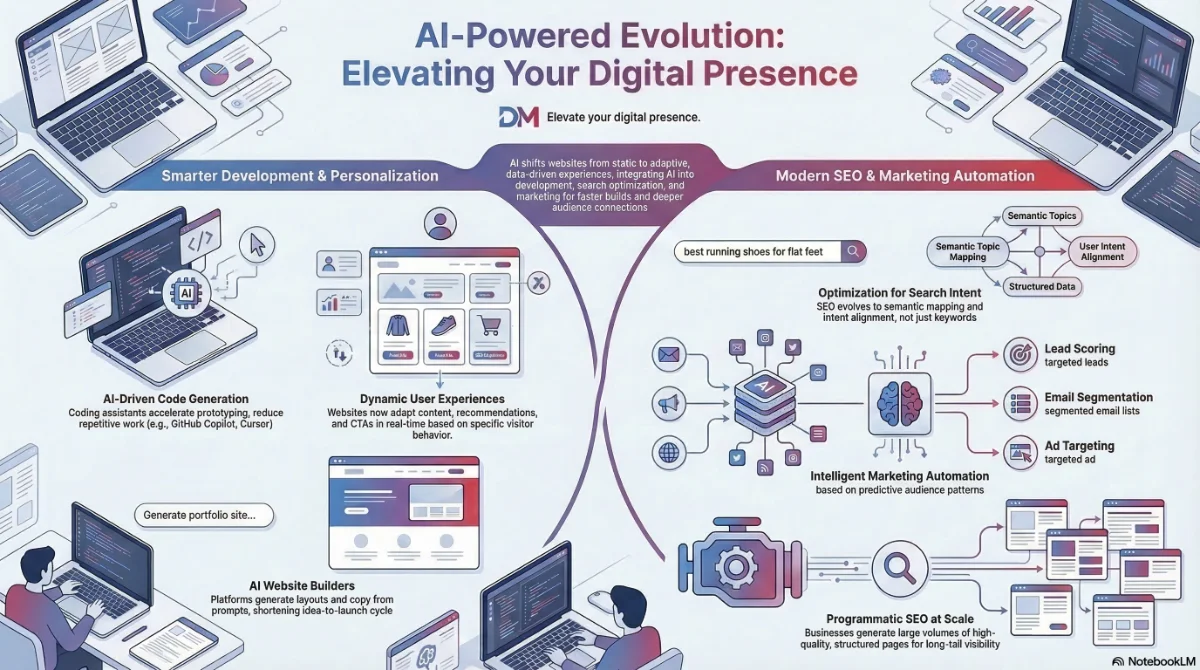
Artificial intelligence is no longer a future concept in digital business. It is already reshaping how websites are built, how content ranks, and how brands connect with audiences online. From AI code assistants to personalized user journeys and automated marketing systems, AI-powered websites are changing the standard for modern digital experiences.
For businesses, developers, and marketers, this shift creates both opportunity and urgency. Organizations that embrace AI can build faster, optimize smarter, and create more relevant user experiences. This guide explains how AI is transforming web development, SEO, and digital marketing, and what that means for the future of your website.
What Are AI-Powered Websites?
AI-powered websites use artificial intelligence to improve how a site is built, managed, optimized, and experienced by users. Rather than relying entirely on static rules and manual workflows, these websites can automate tasks, analyze user behavior, and adapt content or functionality based on data.
Common AI-powered website capabilities include:
- AI-generated content and copy suggestions
- Automated code generation and debugging
- Personalized user experiences
- Intelligent chatbots and virtual assistants
- Predictive analytics and reporting
- Automated search optimization workflows
In simple terms, an AI-powered website is designed to be more responsive, more efficient, and more capable of learning from how users interact with it.
How AI Is Changing Web Development
Artificial intelligence is dramatically changing the development process by speeding up repetitive tasks, improving workflows, and making advanced website creation more accessible to both developers and non-technical teams.
AI Code Generation and Developer Productivity
AI coding assistants are helping developers generate boilerplate code, debug applications faster, and prototype new features with greater speed. Tools like GitHub Copilot, ChatGPT, Cursor, and Codeium can reduce time spent on repetitive development work and free teams to focus on architecture, user experience, and business logic.
With AI support, developers can:
- Generate layout structures and component scaffolding
- Refactor existing code more efficiently
- Identify bugs and logic issues faster
- Accelerate prototyping and MVP development
- Create documentation and inline code explanations
This does not replace developers. It enhances productivity and allows teams to move faster without sacrificing quality when used responsibly.
AI Website Builders and Faster Launch Cycles
AI website builders are also lowering the barrier to entry for launching professional websites. Platforms like Wix AI, Framer AI, and other AI-assisted builders can generate layouts, sections, copy, and visual direction from a prompt or brief business description.
For agencies and businesses, this can shorten the time between idea and launch. For developers, these tools can serve as starting points that are later refined into custom, high-performance solutions.
AI Personalization and Smarter User Experiences
One of AI's most valuable contributions to web development is personalization. Instead of showing every visitor the same content, AI systems can adapt experiences based on user behavior, preferences, or journey stage.
Examples of AI-driven personalization include:
- Dynamic product or content recommendations
- Personalized landing page messaging
- Adaptive calls to action based on intent
- Behavior-driven chat assistance
- Automated testing and content variation analysis
This creates websites that are more relevant to each visitor and more likely to drive engagement and conversions.
How AI Is Transforming SEO
Search optimization is evolving quickly as AI becomes a larger part of how search engines interpret content and how marketers create and optimize pages. Traditional SEO still matters, but success now requires stronger structure, better topical coverage, and content that aligns with modern search intent.
If you want a deeper look at how AI-driven search is evolving beyond traditional SEO, read our related guide on GEO and AEO: The Future of Search Optimization for Businesses in 2026.
AI Content Optimization
AI SEO tools can help marketers analyze top-ranking pages, identify content gaps, and improve on-page optimization. Rather than relying only on manual keyword placement, businesses can now use AI to understand topical relevance and structure content more effectively.
AI-assisted SEO workflows often help with:
- Keyword clustering and semantic topic mapping
- Content brief generation
- Heading and structure recommendations
- Readability and intent alignment
- Internal linking suggestions
These workflows can make content more competitive in search results while reducing production time.
Search Engines Now Rely Heavily on AI
Modern search platforms increasingly use artificial intelligence to understand meaning, context, and user intent. This means ranking well is less about isolated keyword usage and more about publishing content that is useful, trustworthy, structured, and clearly aligned with what users want to know.
As AI-powered search experiences continue to grow, websites must be built with both users and machine interpretation in mind.
Programmatic SEO with AI
AI also supports programmatic SEO, where businesses generate large numbers of valuable, structured pages at scale. This can be especially effective for location pages, service variations, resource hubs, comparison pages, and long-tail informational content.
When done correctly, programmatic SEO allows websites to expand organic visibility without sacrificing usefulness or quality. The key is making sure every page remains genuinely helpful and not just mass-produced filler content.
How AI Is Changing Digital Marketing
AI is not only changing how websites are built and optimized. It is also transforming how businesses market those websites, attract leads, and improve campaign performance.
AI Marketing Automation
Marketing automation has become more intelligent with AI. Instead of relying on simple rules alone, businesses can use AI to make decisions based on behavior, audience patterns, and predictive signals.
AI can support workflows such as:
- Email segmentation and personalization
- Lead scoring and nurturing
- Ad targeting and budget optimization
- Customer journey mapping
- Automated campaign analysis
This helps marketing teams work more efficiently while improving relevance across channels.
AI-Generated Content at Scale
AI content tools make it easier to draft blog posts, product descriptions, landing page copy, ad creatives, and social media captions. For businesses publishing regularly, this can reduce bottlenecks and help teams move faster.
However, strong results still depend on human oversight. The best AI content strategies combine automation with editorial review, brand voice refinement, and subject-matter expertise.
Predictive Analytics and Smarter Decision-Making
AI can also process large datasets to identify patterns humans might miss. This helps businesses understand which campaigns perform best, which users are most likely to convert, and where budget or messaging adjustments can deliver stronger results.
As a result, AI-driven marketing becomes more proactive and less reactive.
Benefits of AI-Powered Websites
1. Faster Website Development
AI can reduce time spent on repetitive development tasks, content drafting, and testing, allowing websites to move from concept to launch more quickly.
2. Better SEO Performance
AI tools can help businesses identify keyword opportunities, optimize content structure, strengthen internal linking, and align pages more closely with user intent.
3. More Personalized User Experiences
AI enables websites to serve more relevant content, recommendations, and calls to action, increasing user engagement and improving conversion potential.
4. Smarter Marketing Operations
AI improves campaign automation, audience targeting, analytics, and content production, helping businesses scale marketing without scaling manual effort at the same rate.
5. Stronger Competitive Positioning
Businesses that adopt AI early can often move faster, create better user experiences, and adapt more quickly to changes in search and digital behavior.
Challenges and Considerations
While AI offers major advantages, businesses should approach implementation thoughtfully. AI can improve speed and scale, but it does not eliminate the need for strategy, quality control, or ethical decision-making.
Content Quality Still Matters
AI-generated copy can accelerate production, but it still requires human editing to ensure clarity, originality, accuracy, and brand alignment.
Over-Automation Can Hurt User Experience
Too much automation can make a website feel generic or impersonal. The goal should be to use AI where it improves the experience, not where it removes human value.
Privacy and Data Use Require Care
Many AI systems rely on behavioral or customer data. Businesses should be transparent about how data is used and ensure their implementation aligns with privacy expectations and applicable regulations.
The Future of AI-Powered Websites
The next generation of websites will likely be more adaptive, more conversational, and more integrated with AI-driven systems than anything businesses have used before. As search evolves, user expectations rise, and content competition increases, static websites will continue to lose ground to more intelligent digital experiences.
Emerging trends include:
- AI-generated and AI-assisted web applications
- More advanced conversational interfaces
- Voice-driven and multimodal user experiences
- AI-enhanced analytics and conversion optimization
- Greater integration between websites, CRMs, and marketing automation systems
The businesses that benefit most will be the ones that use AI strategically, balancing efficiency with quality and automation with trust.
Frequently Asked Questions
What is an AI-powered website?
An AI-powered website uses artificial intelligence to improve development, personalization, SEO, analytics, or marketing performance. It can automate tasks, analyze user behavior, and adapt content or experiences to make the website smarter and more effective.
How is AI changing web development?
AI is changing web development by accelerating code generation, assisting with debugging, improving prototyping speed, enabling AI website builders, and supporting more personalized user experiences. It helps developers work faster while making website creation more accessible overall.
How does AI impact SEO?
AI impacts SEO by improving content optimization, enabling semantic analysis, supporting programmatic SEO, and changing how search engines interpret content. Businesses now need content that is helpful, structured, authoritative, and aligned with modern search intent.
Can AI improve digital marketing results?
Yes. AI can improve digital marketing by automating workflows, personalizing campaigns, optimizing audience targeting, generating content drafts, and using predictive analytics to improve decisions. This often leads to more efficient campaigns and stronger user engagement.
Should businesses rely entirely on AI for websites and content?
No. AI is best used as a support system rather than a full replacement for human strategy, editing, and quality control. Businesses should combine AI efficiency with human expertise to ensure accuracy, trust, and a strong brand experience.