
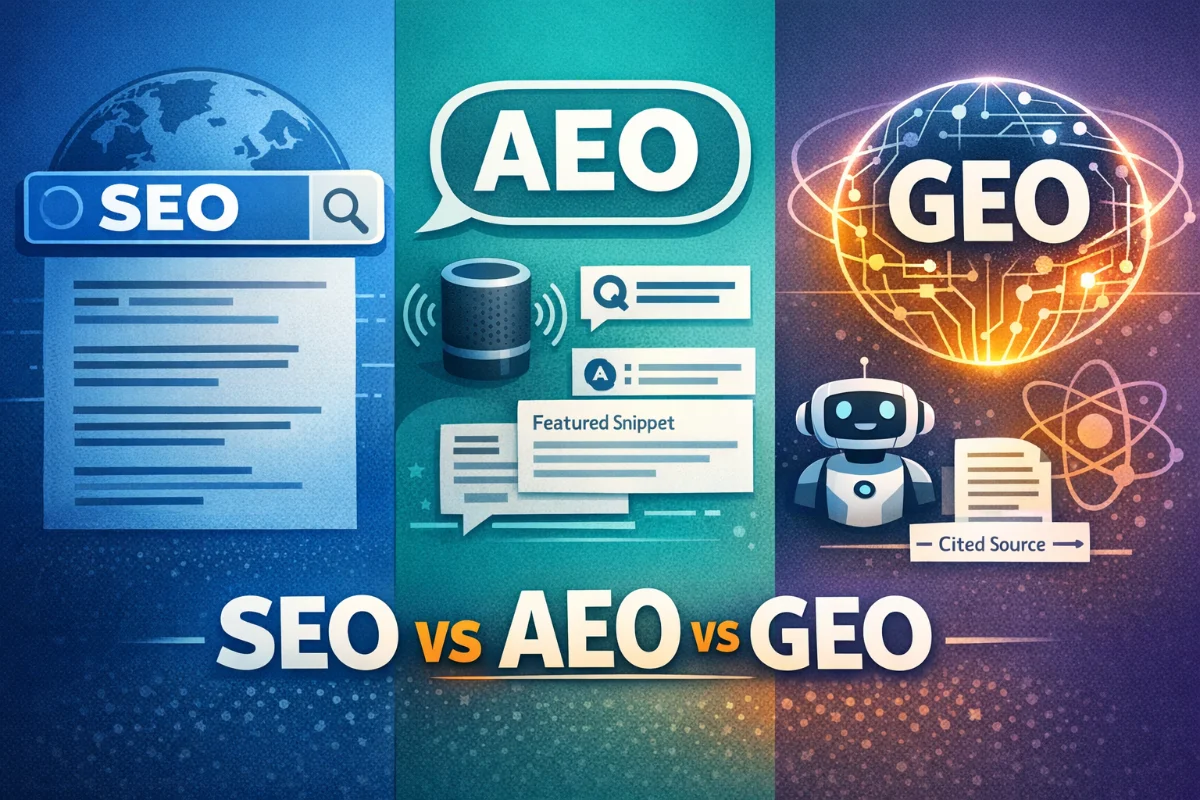
The search landscape is evolving rapidly. While SEO has dominated digital marketing strategies for over two decades, two new paradigms are reshaping how businesses gain visibility online: GEO and AEO.
As AI-powered search tools like ChatGPT, Google's AI Overviews, and Perplexity gain mainstream adoption, businesses that adapt their strategies now will gain a significant competitive advantage. This comprehensive guide explores what GEO and AEO are, how they differ from traditional SEO, and how your business can leverage them for growth.
What is Traditional SEO?
Search Engine Optimization (SEO) is the practice of optimizing web content to rank higher in traditional search engine results pages (SERPs). For years, SEO has focused on:
- Keyword research and optimization
- Backlink building and domain authority
- Technical website performance
- Content quality and relevance
- User experience signals
While SEO remains foundational, the way users search for and consume information is fundamentally changing. Users increasingly expect direct answers rather than a list of links to explore.
What is AEO (Answer Engine Optimization)?
Answer Engine Optimization (AEO) is the practice of optimizing content to appear in direct answer formats, including:
- Featured Snippets — The highlighted answer boxes at the top of Google results
- Voice Search Results — Answers delivered by Siri, Alexa, and Google Assistant
- People Also Ask — Expandable question-and-answer sections in SERPs
- Knowledge Panels — Information boxes about entities, businesses, and topics
Key AEO Strategies
To optimize for answer engines, businesses should:
- Structure content around questions — Use question-based headings that match user queries
- Provide concise, direct answers — Answer questions in 40–60 words immediately after the heading
- Implement structured data markup — Use Schema.org vocabulary to help search engines understand your content
- Optimize for conversational queries — Target natural language phrases people use in voice search
- Build topical authority — Create comprehensive content clusters around key topics
AEO in Practice: Open Graph & Structured Data Examples
Below are concrete examples of how AEO-optimized markup looks in your page's <head>. The key principle: write your og:description as a direct, extractable answer (40–60 words) to the core question your page addresses, and pair it with FAQPage schema so Google can surface your answers in "People Also Ask" and voice results. For more on the Open Graph protocol, see the official Open Graph specification.
AEO Open Graph Tags
<!-- AEO-Optimized Open Graph Tags
     The description is a direct answer (40-60 words)
     so snippet engines can extract it verbatim. -->

<meta property="og:type"        content="article">
<meta property="og:title"       content="What Is AEO? Answer Engine Optimization Explained">
<meta property="og:description" content="AEO (Answer Engine Optimization) is the practice
  of structuring content so it appears in featured snippets,
  voice search results, and People Also Ask boxes. Focus on
  question-based headings and concise 40-60 word answers.">
<meta property="og:url"         content="https://example.com/what-is-aeo">
<meta property="og:image"       content="https://example.com/images/aeo-guide.jpg">
<meta property="og:image:alt"   content="Diagram showing how AEO targets featured snippets">
Notice the og:title is phrased as a question — this mirrors how users search and increases the chance of a featured snippet match. The og:description reads like a self-contained answer a voice assistant could read aloud.
AEO FAQ Structured Data (Schema.org)
FAQPage schema is the single highest-impact AEO markup. When Google encounters valid FAQ JSON-LD, it can render your answers directly in "People Also Ask" and voice search without the user clicking through. For the full specification, see the Schema.org FAQPage type.
<script type="application/ld+json">
{
  "@context": "https://schema.org",
  "@type": "FAQPage",
  "mainEntity": [
    {
      "@type": "Question",
      "name": "What is AEO?",
      "acceptedAnswer": {
        "@type": "Answer",
        "text": "AEO stands for Answer Engine Optimization. It is the
          practice of optimizing content to appear in featured snippets,
          voice search results, and People Also Ask sections."
      }
    },
    {
      "@type": "Question",
      "name": "How do I optimize for AEO?",
      "acceptedAnswer": {
        "@type": "Answer",
        "text": "Use question-based headings, provide concise 40-60 word
          answers, implement Schema.org markup, and optimize for
          conversational voice queries."
      }
    }
  ]
}
</script>
Tip: Keep each acceptedAnswer between 40–60 words. This is the sweet spot Google targets for featured snippet extraction. Every answer should stand alone — voice assistants read a single answer with no surrounding context.
What is GEO (Generative Engine Optimization)?
Generative Engine Optimization (GEO) is the emerging practice of optimizing content to be discovered, cited, and recommended by AI-powered generative search engines. The term was formalized by researchers at Princeton University and IIT Delhi in their 2024 GEO research paper, published at KDD 2024. These AI-powered engines include:
- ChatGPT with web browsing capabilities
- Google AI Overviews (formerly Search Generative Experience)
- Perplexity AI
- Microsoft Copilot
- Claude and other AI assistants
Unlike traditional search engines that display links, generative engines synthesize information from multiple sources and present conversational, comprehensive answers. Being cited as a source in these AI-generated responses is the new frontier of digital visibility.
Key GEO Strategies
To optimize for generative AI engines, businesses should focus on:
- Establish E-E-A-T signals — Demonstrate Experience, Expertise, Authoritativeness, and Trustworthiness throughout your content (per Google's helpful content guidance and the Search Quality Rater Guidelines)
- Create uniquely valuable content — Offer original research, data, insights, and perspectives that AI models will want to cite
- Use clear, factual statements — AI models favor content with definitive, accurate information that can be easily extracted
- Build brand recognition — Generative engines often cite well-known, authoritative sources by name
- Maintain content freshness — Regularly update content with current information and dates
- Optimize for quotability — Create memorable, well-structured statements that AI can directly quote
GEO in Practice: Open Graph & Structured Data Examples
GEO markup serves a different purpose than AEO. Instead of writing descriptions as snippet answers, you optimize for brand citation — include the author's name, organization, and a claim of expertise so that when an AI model summarizes your page, it naturally attributes the content to your brand.
GEO Open Graph Tags
<!-- GEO-Optimized Open Graph Tags
     The description leads with the author and org
     to encourage AI models to cite the source. -->

<meta property="og:type"              content="article">
<meta property="og:title"             content="GEO: How to Get Cited by ChatGPT
  & Perplexity — Albert Bretado">
<meta property="og:description"       content="Web developer Albert Bretado explains
  Generative Engine Optimization (GEO) — strategies for getting your content cited
  by AI assistants including ChatGPT, Perplexity, and Google AI Overviews.
  Based on original research and hands-on testing.">
<meta property="og:url"               content="https://example.com/geo-guide">
<meta property="og:image"             content="https://example.com/images/geo-guide.jpg">
<meta property="og:image:alt"         content="Flowchart showing how AI models
  select and cite sources in generated responses">
<meta property="article:author"       content="Albert Bretado">
<meta property="article:published_time" content="2026-02-01T12:00:00Z">
<meta property="article:modified_time"  content="2026-02-01T12:00:00Z">
Compare this to the AEO example above: the og:title includes the author name for attribution, the og:description leads with who wrote it and why they're credible, and the article:modified_time tag signals freshness — a strong citation signal for LLMs.
GEO Article + Author Schema (JSON-LD)
The most impactful GEO structured data is Article combined with a detailed Person author and Organization publisher. AI crawlers use these signals to evaluate E-E-A-T. The richer your author markup — credentials, sameAs links, job title — the more likely an LLM is to treat your content as authoritative and citable.
<script type="application/ld+json">
{
  "@context": "https://schema.org",
  "@type": "Article",
  "headline": "GEO: How to Get Cited by AI Search Engines",
  "datePublished": "2026-02-01",
  "dateModified": "2026-02-01",
  "author": {
    "@type": "Person",
    "name": "Albert Bretado",
    "jobTitle": "Web Developer",
    "url": "https://example.com/about",
    "sameAs": [
      "https://www.linkedin.com/in/albertbretado/",
      "https://github.com/albertbretado"
    ]
  },
  "publisher": {
    "@type": "Organization",
    "name": "Deviant Media LLC",
    "url": "https://example.com",
    "logo": {
      "@type": "ImageObject",
      "url": "https://example.com/images/logo.png"
    }
  },
  "mainEntityOfPage": {
    "@type": "WebPage",
    "@id": "https://example.com/geo-guide"
  }
}
</script>
Tip: The sameAs array links to your LinkedIn, GitHub, and other verified profiles — this creates a web of identity signals that AI models cross-reference when deciding whether to cite a source. Always include dateModified and keep it current; freshness is one of the strongest citation signals for generative engines.
AEO vs. GEO: How the Same Tags Serve Different Purposes
The table below summarizes how the same markup elements are used differently depending on whether you're optimizing for answer engines (AEO) or generative engines (GEO):
| Tag / Markup | AEO Purpose | GEO Purpose |
|---|---|---|
og:description |
Written as a direct, extractable answer (40–60 words) | Written to include author name, org, and expertise claim for citation |
og:title |
Phrased as a question or includes the target query | Includes author name and brand for AI attribution |
FAQPage schema |
Primary markup — drives "People Also Ask" and voice results | Supporting markup — provides structured answers for AI extraction |
Article schema |
Supporting markup — signals content type | Primary markup — establishes authorship, publisher, and freshness |
author.sameAs |
Optional — minor relevance for snippets | Critical — cross-references identity for E-E-A-T trust signals |
dateModified |
Helpful for freshness in SERPs | Critical — LLMs prioritize recently updated sources |
SEO vs. AEO vs. GEO: Key Differences
| Aspect | SEO | AEO | GEO |
|---|---|---|---|
| Primary Goal | Rank high in search results | Appear in featured snippets and voice results | Be cited by AI-generated responses |
| Target Platform | Google, Bing SERPs | Answer boxes, voice assistants | ChatGPT, Perplexity, AI Overviews |
| Content Format | Keyword-optimized pages | Q&A structured content | Authoritative, quotable content |
| Success Metric | Rankings and organic traffic | Featured snippet appearances | AI citations and brand mentions |
| User Interaction | User clicks through to website | User may get answer without clicking | User receives synthesized answer with citations |
How GEO and AEO Benefit Your Business
1. Increased Brand Visibility in the AI Era
As more users turn to AI assistants for information, businesses optimized for GEO and AEO maintain visibility even when users don't perform traditional searches. Being cited by ChatGPT or appearing in a featured snippet positions your brand as an authority.
2. Higher Quality Traffic
Users who click through from AI citations or featured snippets are often further along in their decision-making process. They've received initial information and are seeking deeper engagement, resulting in higher conversion rates.
3. Competitive Differentiation
Most businesses are still focused exclusively on traditional SEO. Early adoption of GEO and AEO strategies provides a significant first-mover advantage in capturing AI-driven search visibility.
4. Voice Search Dominance
With over 50% of adults using voice search daily, AEO optimization ensures your business is the answer when customers ask their smart devices for recommendations and information.
5. Future-Proofing Your Digital Strategy
The trajectory is clear: AI will play an increasingly central role in how people discover information and make decisions. Investing in GEO and AEO now prepares your business for the future of search.
Implementing a Combined SEO, AEO, and GEO Strategy
The most effective approach integrates all three optimization strategies. Here's a practical framework:
Step 1: Audit Your Current Content
Evaluate your existing content for SEO fundamentals, then identify opportunities to restructure it for answer engines and generative AI citation.
Step 2: Create Question-Focused Content
Develop content that directly addresses the questions your target audience asks. Use tools like AnswerThePublic, AlsoAsked, and Google's "People Also Ask" for research.
Step 3: Implement Structured Data
Add FAQ schema, HowTo schema, and other relevant structured data markup to help both traditional and AI-powered search engines understand your content.
Step 4: Build Authoritative, Citable Content
Create original research, industry reports, and definitive guides that AI models will recognize as authoritative sources worth citing.
Step 5: Monitor and Adapt
Track your featured snippet appearances, monitor AI citations using tools designed for GEO tracking, and continuously refine your strategy based on results.
The Future of Search Optimization
The search ecosystem is no longer limited to ten blue links on a results page. Today's users expect immediate, accurate, and conversational answers delivered through multiple channels—from traditional search results to voice assistants to AI chatbots.
Businesses that embrace GEO and AEO alongside traditional SEO will capture visibility across this evolving landscape. The question isn't whether AI will transform search—it already has. The question is whether your business will adapt quickly enough to thrive in this new reality.
Start optimizing for the future of search today. Your competitors already are.
Frequently Asked Questions
What does GEO stand for and what is it?
GEO stands for Generative Engine Optimization. It is the practice of optimizing your content to be discovered, cited, and recommended by AI-powered generative search engines like ChatGPT, Google AI Overviews, Perplexity AI, and Microsoft Copilot. The goal is to have your content referenced as a source in AI-generated responses.
What does AEO stand for and what is it?
AEO stands for Answer Engine Optimization. It is the practice of optimizing content to appear in direct answer formats such as featured snippets, voice search results, People Also Ask sections, and knowledge panels. AEO focuses on providing concise, structured answers to user questions.
What is the difference between SEO, AEO, and GEO?
SEO focuses on ranking high in traditional search engine results pages. AEO focuses on appearing in featured snippets and voice search results by providing direct answers to questions. GEO focuses on being cited by AI-powered tools like ChatGPT and Perplexity. While SEO drives clicks to your website, AEO and GEO focus on visibility within answer formats and AI-generated responses.
Is SEO still relevant with GEO and AEO?
Yes, SEO remains foundational and highly relevant. GEO and AEO are complementary strategies that build upon SEO fundamentals. A strong SEO foundation—including quality content, technical optimization, and authority signals—supports both AEO and GEO success. The most effective digital strategy integrates all three approaches.
How can I optimize my content for GEO?
To optimize for GEO, focus on establishing E-E-A-T signals (Experience, Expertise, Authoritativeness, Trustworthiness), creating uniquely valuable content with original research and data, using clear factual statements, building brand recognition, maintaining content freshness, and writing quotable statements that AI can easily extract and cite.
How can I optimize my content for AEO?
To optimize for AEO, structure your content around questions using question-based headings, provide concise direct answers (40-60 words) immediately after each heading, implement structured data markup using Schema.org, optimize for conversational and voice search queries, and build topical authority through comprehensive content clusters.
What are the benefits of GEO and AEO for businesses?
GEO and AEO offer several benefits including increased brand visibility in AI-powered search, higher quality traffic from users further along in their decision-making process, competitive differentiation through early adoption, dominance in voice search results, and future-proofing your digital strategy as AI continues to transform how people discover information.
What AI tools should I optimize for with GEO?
Key AI tools to optimize for with GEO include ChatGPT with web browsing capabilities, Google AI Overviews (formerly Search Generative Experience), Perplexity AI, Microsoft Copilot, and Claude. These generative engines synthesize information from multiple sources and cite authoritative content in their responses.
How do I measure success with GEO and AEO?
For AEO, track featured snippet appearances, voice search visibility, and People Also Ask inclusions using SEO tools. For GEO, monitor AI citations and brand mentions using emerging GEO tracking tools, manually check AI responses for your brand mentions, and track referral traffic from AI platforms. Both require ongoing monitoring and strategy refinement.
Should I implement SEO, AEO, and GEO together?
Yes, implementing all three strategies together is the most effective approach. Start by auditing your current content for SEO fundamentals, then restructure content for answer engines (AEO), and finally optimize for AI citations (GEO). This integrated approach ensures maximum visibility across traditional search, answer boxes, voice search, and AI-generated responses.